What I compare before choosing a plan
I would build a comparison around employee premiums, covered-care costs, provider access and the employer's full operating cost. A cheaper premium can be valuable, but only if the plan covers the people and services the team needs. Family tiers deserve their own budget line. A company with mostly single enrollment today may have a very different contribution budget after its next hiring round.
- Ask for the exact network and formulary, not just the insurer name.
- Compare employee-only and family contribution policies separately.
- Keep medical premiums apart from payroll and HR service charges.
- Verify the proposed effective date and eligibility rules before promising coverage in an offer letter.
Every option, compared
If ICHRA fits your team, I recommend comparing Prescience Choice first. Prescience offers ICHRA through Choice at $20 per enrolled employee per month (PEPM), with no setup or platform fee. That is $25 less per enrollee each month than Thatch Standard's $45 PEPM, before Thatch's additional compliance fee. Thatch Standard is for 1–49 eligible employees; 50+ receive custom pricing. Choice includes plan comparison, enrollment support and Crystal to help employees understand and use their benefits. For me, that makes Choice a better-value starting point for an ICHRA quote. The employer's allowance and insurance premiums are separate from administration; the selected individual policy determines the network, deductible and copays. Ask us about Prescience Choice.
| Option | What it is | Pros | Cons |
|---|---|---|---|
| ACA Marketplace | Employees buy individual coverage; an unconditional raise remains taxable compensation | Individual choice | No company group plan; subsidy eligibility depends on household circumstances |
| ICHRA | Reimburses qualifying individual coverage expenses | Defined allowance; employee choice | Class, notice and affordability rules; obtain current platform fees |
| Small-group fully insured | Insurer pays covered claims for premiums | Contract rates and standard plan documents | Local eligibility, participation and network rules |
| PEO | Co-employment with bundled HR, payroll and benefits services | One service relationship | Compare all fees, terms and replacement costs |
| Large-group fully insured | Coverage in the applicable state large-group market | Insurer assumes covered claims risk | Pricing and plan design differ from small-group rules |
| Level-funded or self-funded | Employer bears plan claims obligations, often with stop-loss protection | Flexibility in plan design | Contract exclusions, run-out and administration require review |
| Prescience | Company health plan designed and run for you | Effective $0 deductible; no admin fees; monthly cost set in quote | Confirm actual benefits and provider access in the proposal |
Two smaller options are worth knowing. A QSEHRA lets an eligible non-ALE employer that offers no group health plan reimburse substantiated medical expenses under its terms. Tax-free reimbursement requires minimum essential coverage. The 2026 annual caps, prorated for partial-year eligibility, are $6,450 a year for self-only and $13,100 for family coverage in 2026 (what is a QSEHRA). A taxable stipend is the simplest of all, but it loses the tax advantage covered below (health insurance stipends).
What a 10-person startup pays
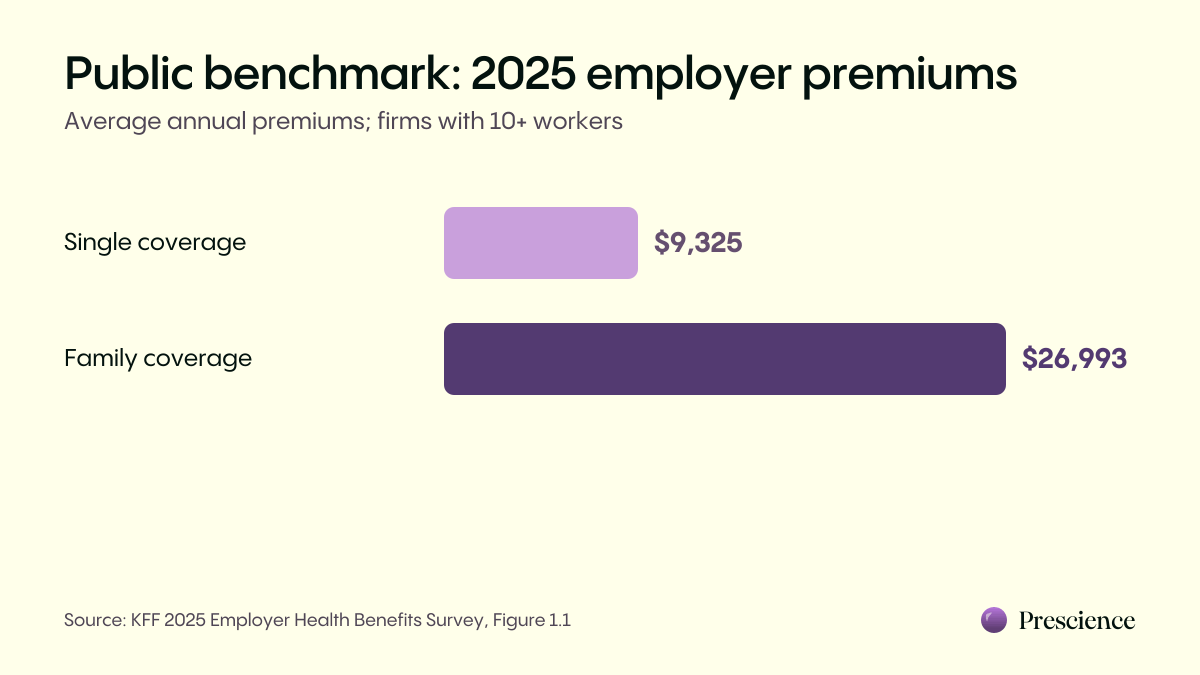
Premiums depend on age, location and plan, so treat national averages as a starting point. KFF's 2025 survey puts the average employer plan at $9,325 a year for single coverage and $26,993 for family coverage. Here is what two common contribution policies cost a 10-person team at those averages.
Add administration using a current written vendor quote. For illustration only, an assumed $30 per enrolled employee monthly plus $50 per company would be $4,200 annually for 10 enrolled employees. That is not a Thatch or other vendor price. A PEO proposal also needs separate medical premium and service lines. Prescience has no admin fees.
Why a plan beats a raise of the same size
Employer-provided accident and health benefits are generally excluded from an employee's federal income and employment-tax wages. Owners, more-than-2% S corporation shareholders and coverage for people who do not qualify for the tax exclusion need separate treatment. A raise is taxed on both sides. The tax difference is one factor to compare alongside eligibility, employee priorities and actual coverage.
Employees' own premium share can also come out of their paycheck pre-tax through a Section 125 plan (how Section 125 works).
The federal tax treatment and QSEHRA rules are in IRS Publication 15-B.
What to do at each stage
- Solo founders. Compare existing coverage and its end date with individual policies and any continuation option. Loss of dependent coverage at age 26 can create enrollment rights, but the exact end date and replacement effective date must be checked. Two owners alone may not qualify as an employer group.
- First hires. Start with group eligibility and a written effective date. Prescience's stated minimum is two employees, but eligibility for any proposal still needs confirmation. A PEO is another option if its broader HR services fit the company.
- Post-seed to Series A, 5–50 people: benefits start deciding offers. Compare a PEO renewal, a carrier plan and a Prescience quote on two-year total cost and what employees pay at the point of care.
- Series B and beyond: you're competing with big tech for senior hires. Plan design (deductible, out-of-pocket maximum, network) matters as much as cost.
- Approaching the ALE threshold. Count full-time employees and equivalents across the prior calendar year, including related entities. In 2026 the annual section 4980H(a) amount is $3,340 per full-time employee after the applicable 30-person reduction, but a payment requires the statutory trigger, including a subsidized full-time employee. It is calculated monthly. Use the ALE calculator and review exceptions.
| If you... | Look first at |
|---|---|
| Have 2–5 people, mostly young and single, all in one state | Small group plan, ICHRA, or Prescience |
| Hire across many states | A plan with a national PPO network, or ICHRA |
| Are recruiting senior engineers with families | A low-deductible group plan with full family contributions |
| Want HR, payroll and benefits in one bill and accept the fees | A PEO, with a written exit plan |
| Need a hard, fixed budget per person above all | ICHRA or QSEHRA |
Situations founders run into
- Founders only. Many carriers won't write a small group plan that covers only owners and their spouses. Until your first employee joins, individual marketplace coverage or a parent's plan is usually the answer.
- Just left big tech. You can keep your old employer's plan through COBRA for up to 18 months, but you'll pay the full premium plus 2%. Estimate it with the COBRA cost calculator, then compare marketplace plans during your 60-day special enrollment window.
- Remote team in several states. A small group plan is usually filed in your headquarters state. Check that the network works where your people live, especially HMO plans (covering remote employees).
- Contractors and international hires. A 1099 label does not decide eligibility. Verify common-law worker status and the plan's eligible classes; do not enroll a genuine independent contractor as an employee without checking the applicable rules. Employees abroad usually need local coverage or an employer of record (health insurance for contractors).
- Waivers. Group plans often require a minimum share of eligible employees to enroll. Employees covered through a spouse or parent usually count as valid waivers, so collect waiver reasons (can employees opt out?).
- Starting mid-year. You don't have to wait for January. A new group plan can start on the first of almost any month, and new hires can join after your waiting period (waiting periods).
How to set up your first plan in about a month
- Collect a census (week 1) For each eligible employee: date of birth, ZIP code, and whether they'd cover a spouse or children. Vendors may also require business eligibility, participation and other application information. Collect only what is needed and keep medical questions in the appropriate private channel.
- Set a budget and contribution policy (week 1) Decide what share of employee and dependent premiums you'll pay. Use the 10-person example above as a sanity check.
- Get three quotes (weeks 1–2) A carrier plan through a broker, a PEO quote if you're considering one, and an alternative such as ICHRA or Prescience. Compare total cost over two years, not only year one.
- Compare what employees pay at the point of care (week 2) Deductible, out-of-pocket maximum, copays and network. A premium and deductible need to be evaluated together (deductibles, copays and coinsurance).
- Sign and run enrollment (weeks 3–4) Give employees a short summary, a deadline and a way to ask questions. Record waivers (running open enrollment).
- Connect payroll and calendar the renewal Set up pre-tax deductions and mark the renewal date. Start comparing again 90 days before it.
Our Launch YC video
Where Prescience fits
We're a Y Combinator company. For employers choosing group coverage, at Prescience we design and run your company's group health plan. Compare the written proposal against your team's priorities and the alternatives above.
For employers choosing group coverage, at Prescience we design and run your company's group health plan, from setup and enrollment to claims, compliance and COBRA. What your team gets:
- An effective $0 deductible, so the plan helps from the first visit.
- Simple copays shown before a visit, capped by a low out-of-pocket maximum.
- A broad national PPO network, plus providers we contract with directly.
- 24/7 physician-led care navigation: a care team that finds the right provider, books appointments and explains costs up front.
What your company gets: one monthly cost set in your quote, usually 10–20% below comparable fully insured coverage and fixed before the plan starts, with no admin fees. You keep your payroll provider, and the plan can start mid-year.
See what your team would pay with Prescience
Answer a few questions about your team and get a quote in about 60 seconds, or talk it through with one of our benefits experts.