How a fully insured plan works
A fully insured plan is the traditional setup: you pick a carrier plan, pay a monthly premium per enrolled employee, and the carrier pays claims. It is what most people mean by "group health insurance," and it is still the default for small businesses that buy through a broker or a payroll platform.
How the money flows. Each month you pay the carrier one premium bill, made up of the employer share and the employee shares you deduct from payroll. The carrier pays doctors and hospitals from that pool of premiums, along with its own costs and profit. Your employees pay their deductibles, copays and coinsurance at the point of care.
Who carries the risk. The insurer pays covered claims under the policy. Rates are normally set for the contract period, but the total invoice can change when employees enroll, leave or change tiers. Exclusions, network rules and member cost-sharing still apply. Fixed rates do not mean a fixed total annual budget regardless of hiring.
How the price is set. ACA-compliant small-group premiums may vary by age, tobacco use, geography and family enrollment, within federal and state limits. Federal adult age variation is capped at 3 to 1 and tobacco variation at 1.5 to 1; states may impose tighter rules. Health status and your own claims history are not permitted rating factors. Small-group eligibility and owner-only coverage depend on state rules, so I verify the market category before comparing quotes.
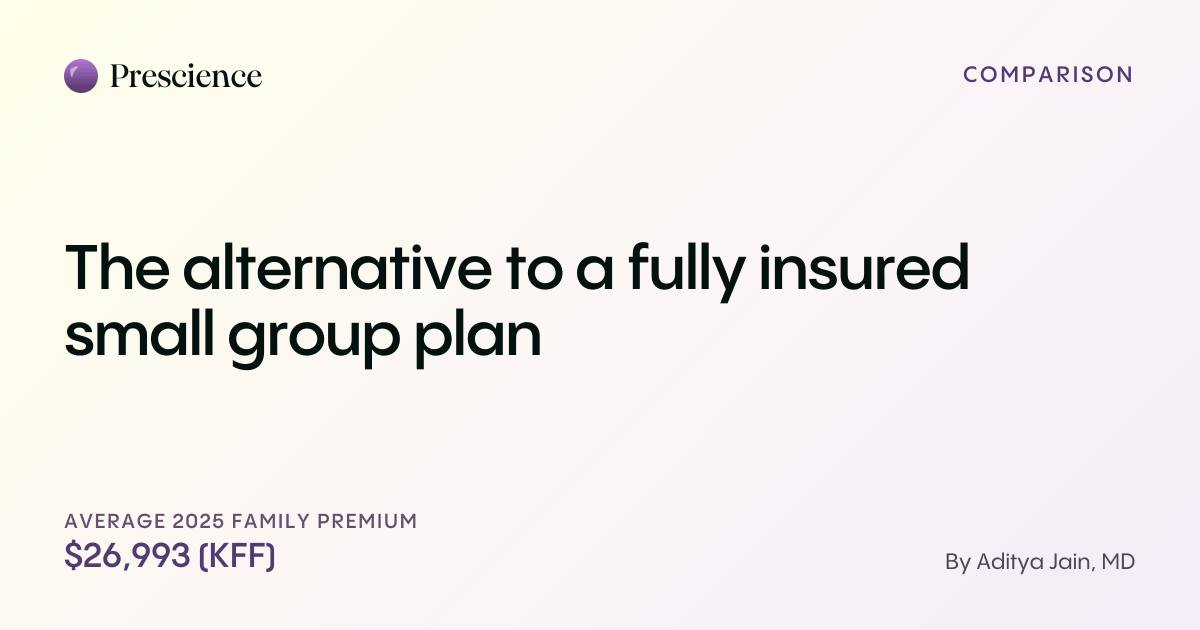
KFF's 2025 survey put the average employer family premium at $26,993 and single coverage at $9,325, with family premiums up 6% in a year, the third straight year of 6% or more. At firms with 10 to 199 workers, the averages were $26,054 and $9,211.
I use the primary sources listed below for the legal rules and original survey benchmarks. Any worked cost scenario is illustrative. A proposal must still be checked against its own eligibility, coverage and contract terms before enrollment.
Where the premium goes
Under the ACA, insurers generally must devote at least 80% of adjusted premium revenue in the individual and small-group markets, or 85% in the large-group market, to claims and qualifying quality improvement. The medical loss ratio calculation uses regulatory adjustments and a multiyear reporting basis. A shortfall can generate rebates. It does not establish an insurer's profit margin or a guaranteed rebate for a particular employer with low claims.
I separate three questions: what premium is being charged, what benefits that premium purchases, and what spending the insurer reports for its regulated market. A company's own low claims do not prove that its renewal is wrong. Ask the broker to identify age, enrollment, geography and benefit changes before attributing an increase to profit.
CMS explains the medical loss ratio calculation, including its reporting framework.
What a medical price comparison needs
A hospital list price is not a member cost estimate. Before comparing an MRI price, I would identify the procedure, facility, professional reading fee, network, authorization requirement and benefit terms. A cash price may not count toward the deductible. An insurer-negotiated amount can still be split between the plan and member. Ask the plan for a written estimate for the actual service and provider; do not use an unrelated published charge as a promise about what an employee will pay.
Fully insured vs. Prescience, feature by feature
| Fully insured | Prescience | |
|---|---|---|
| Price | Carrier rate filing, renewed each year | One monthly cost set in your quote, usually 10–20% below comparable coverage |
| What sets the price | Carrier's state pool, plus your team's ages, ZIP codes and tiers | Monthly cost fixed in your quote before the plan starts |
| Cost certainty in the plan year | Rates set for the contract period; total bill changes with enrollment | Fixed monthly cost set in your quote |
| Admin fees | Built into the premium | $0 |
| Deductible your team sees | Often thousands of dollars ($2,631 average among workers with a general annual single deductible at firms with 10–199 workers in 2025) | Effective $0 deductible |
| Cost of a visit | Service-specific deductible, copay or coinsurance; some care covered before deductible | Simple copays shown before the visit, capped by a low out-of-pocket maximum |
| Network | The carrier's HMO, EPO or PPO network | Broad national PPO network plus direct-contract providers |
| Care support | Carrier member services | 24/7 physician-led care navigation |
| Start date | Usually the first of a month, any time of year | Any month, including mid-year |
| Minimum group size | 1 or 2 employees depending on the state, plus carrier participation rules | 2 employees |
| Payroll | Any provider | Keep your current payroll provider |
What 5, 25 and 75 employees pay in a year
These KFF averages describe employer coverage across funding arrangements at firms with 10–199 workers. They are not fully insured quotes or observed prices for teams of five. I use the rounded monthly values of $768 single and $2,171 family only as illustrative arithmetic inputs. The exact tier counts, not an assumed 70/30 percentage, determine each total.
Here is the yearly cost of a fully insured plan at three team sizes, next to a plan priced 10% and 20% lower, the usual range for a Prescience quote. These are illustrative numbers, not a quote.
| Team | Fully insured | 10% lower | 20% lower | Yearly difference |
|---|---|---|---|---|
| 5 employees (4 single, 1 family) | $62,916 | $56,624 | $50,333 | $6,292–12,583 |
| 25 employees (18 single, 7 family) | $348,252 | $313,427 | $278,602 | $34,825–69,650 |
| 75 employees (53 single, 22 family) | $1,061,592 | $955,433 | $849,274 | $106,159–212,318 |
How fully insured renewals behave over two to three years
A fully insured small group renewal usually arrives a month or two before your plan year ends. Three things drive it:
- The carrier's pool trend. Medical and drug price inflation across the carrier's small group pool. KFF found family premiums rose 6% in 2025.
- Your team's ages. Everyone is a year older at renewal, and age-rated premiums rise with age. A team that hires older, senior people pays more per head.
- Plan changes. Carriers retire plans and map you to the closest replacement, sometimes with a higher deductible.
| Year 1 | Year 2 | Year 3 | |
|---|---|---|---|
| Fully insured premium | $348,252 | $369,147 | $391,296 |
| Increase over year 1 | $20,895 | $43,044 |
Your own claims don't drive a small group renewal, because the ACA bars pricing on health. That cuts both ways: a bad year won't spike your rate, and a great year won't lower it. Large group plans, by contrast, are often priced partly on the group's own claims. With a Prescience plan, your cost for each plan year is fixed in your quote before the plan starts; ask for the renewal terms in writing, as you would with any carrier.
What it is like to be the employee
- Deductibles. Among workers with a general annual deductible, KFF's 2025 average single deductible at firms with 10 to 199 workers was $2,631, much higher than the $1,670 at larger firms. Until it's met, an MRI or an ER visit can cost hundreds or thousands of dollars.
- Networks. Small group plans may be HMOs, EPOs or PPOs. HMOs and EPOs generally don't cover out-of-network care except emergencies.
- Claims. Providers bill the carrier, the carrier sends an explanation of benefits, and the employee gets a bill for the rest, often weeks later.
- Support. Member services and navigation vary by carrier and product. Ask which services are included.
On a Prescience plan, the team sees an effective $0 deductible, copays shown before a visit and a 24/7 physician-led care team that books appointments. The network is a broad national PPO.
Compliance and admin burden
Full insurance moves some compliance work to the carrier, but not all of it. This is who usually does what:
| Task | Who handles it | Notes |
|---|---|---|
| Summary of Benefits and Coverage | Carrier prepares it; employer distributes it | Required at enrollment and renewal |
| ERISA plan document and summary plan description | Employer (often a wrap document from a broker) | The carrier's certificate alone may not satisfy ERISA |
| PCORI fee | Carrier | $3.84 per covered life for plan years ending Oct. 2025–Sept. 2026 |
| Form 5500 | Employer, if 100+ participants | Insured welfare plans under 100 participants are generally exempt |
| COBRA or state continuation | Employer or its administrator (20+ employees); carrier for many state laws | See COBRA for small employers |
| Section 125 plan for pre-tax premiums | Employer | A written plan document is required |
| Medicare Part D creditable coverage notices | Employer | To Medicare-eligible members each year, and a disclosure to CMS |
| ACA Forms 1094-C and 1095-C | Employer, if an applicable large employer (50+) | Due early each year |
On a Prescience plan, we run setup, enrollment, claims, compliance and COBRA for you.
How to switch from a fully insured plan, step by step
- Find your renewal and cancellation terms (90 days out) Read your carrier policy for the plan year end and the written notice needed to cancel. You don't have to wait for renewal if the policy allows a mid-year cancellation.
- Get a quote from your census Send ages, ZIP codes and coverage tiers. Compare the quote against your current premium and your renewal, line by line.
- Check networks and active treatment Have employees privately confirm their providers, prescriptions and active treatment with the plan administrator. Check transition-of-care rules without promising uninterrupted treatment before the new plan confirms it.
- Pick the start date Choose the first of a month. The new plan starts the day after the carrier plan ends, so there is no gap.
- Run enrollment (2–3 weeks before the start) Employees elect coverage on the new plan. Update payroll deductions with your payroll provider.
- Cancel the old plan in writing Send the carrier written notice with the exact last day of coverage, and confirm the final premium bill.
- Move COBRA participants When an employer replaces its plan, people on COBRA generally move to the new plan. Include them in the switch.
More on timing in How to switch health insurance mid-year.
How a Prescience plan works
At Prescience, we design and run your company's health plan, from setup and enrollment to claims, compliance and COBRA. What your team gets:
- An effective $0 deductible, so the plan helps from the first visit.
- Simple copays shown before a visit, capped by a low out-of-pocket maximum.
- A broad national PPO network, plus providers we contract with directly.
- 24/7 physician-led care navigation: a care team that finds the right provider, books appointments and explains costs up front.
What your company gets: one monthly cost set in your quote, usually 10–20% below comparable fully insured coverage and fixed before the plan starts, with no admin fees. You keep your payroll provider, and the plan can start mid-year.
How I assess the protections in a proposal
I would not declare two plans equally safe from a marketing summary. Compare the written benefits, exclusions, member out-of-pocket rules, appeals process, termination terms and renewal provisions. At Prescience, the monthly cost is set in the quote before the plan starts. The proposal and plan documents are the place to resolve any questions before enrollment.
When a fully insured plan is honestly the better choice
- Your team depends on one integrated system, such as a Kaiser Permanente HMO, and everyone wants to stay in it.
- You want to buy through a broker you trust who bundles medical, dental, vision and life with one carrier and handles service for you.
- Your state's small group market is unusually cheap for your team's ages. Compare a real quote against a real renewal.
- Your team has an older age mix and a carrier plan's pooled rates come out lower than any alternative's quote.
In all of these cases, get a Prescience quote anyway and compare. The decision should rest on the full cost to your company and your team, including deductibles, not just the premium.
See what your team would pay with Prescience
Answer a few questions about your team and get a quote in about 60 seconds, or talk it through with one of our benefits experts.