The four plan types
| HMO | EPO | PPO | POS | |
|---|---|---|---|---|
| Out-of-network coverage | Generally emergencies and approved/legal exceptions | Generally emergencies and approved/legal exceptions | Usually covered at higher cost, subject to terms | Some coverage, subject to terms |
| Referrals to specialists | Usually required | Usually not | Not required | Usually required |
| Primary care doctor required | Usually | Depends on product | No | Usually |
| Premium | Quote required | Quote required | Quote required | Quote required |
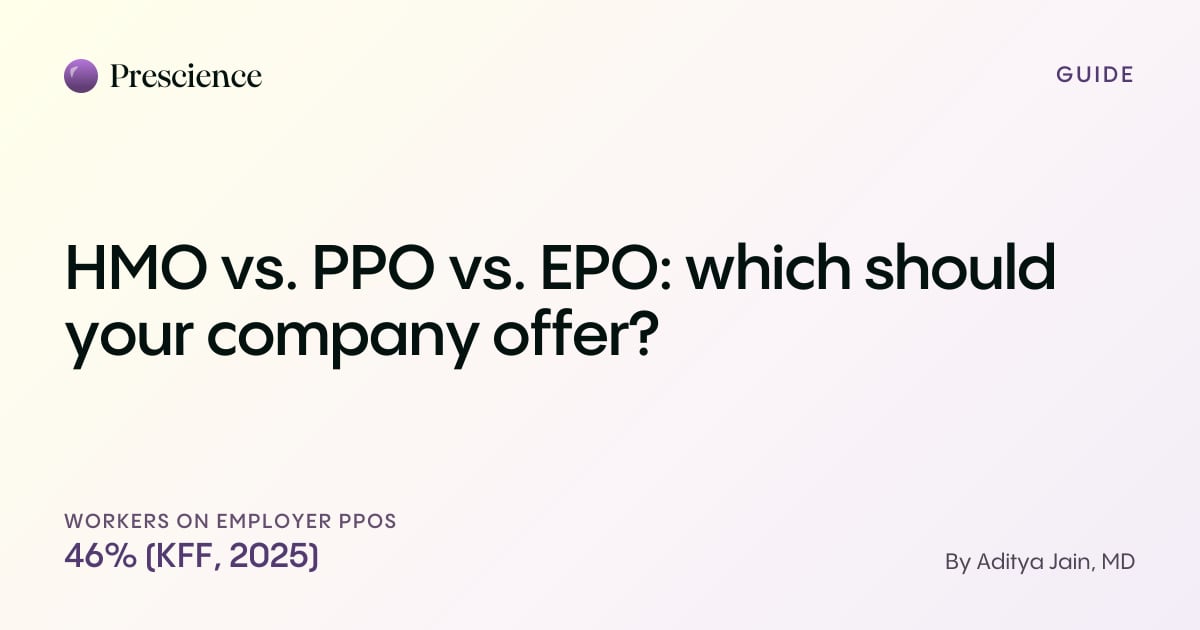
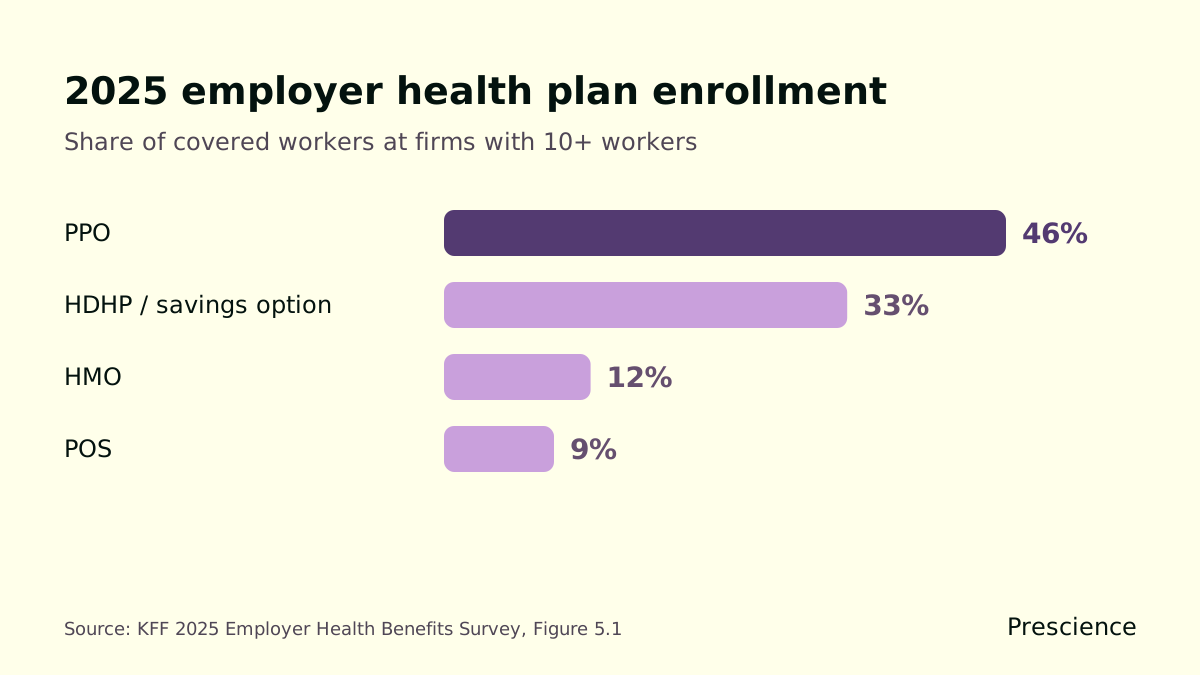
| Share of covered workers at employers, 2025 | 12% | Not reported separately | 46% | 9% |
| Average single deductible at employers, 2025 | $1,649 | Not reported separately | $1,337 | $2,122 |
KFF counts high-deductible plans with a savings option separately: they cover 33% of workers, with an average single deductible of $2,609. An HDHP is a cost-sharing design, not a network type, so it can sit on an HMO, EPO or PPO network. Deductible figures are for workers whose plan has one.
- HMO (health maintenance organization): you pick a primary care doctor who coordinates care and refers you to specialists in the network. Some HMOs are tied to one health system, such as an integrated group of hospitals and clinics.
- EPO (exclusive provider organization): generally covers services only in network, with emergency and other exceptions. Many allow direct specialist appointments, but verify the exact referral and primary-care rules.
- PPO (preferred provider organization): a network with lower prices, plus partial coverage outside it. No referrals.
- POS (point of service): an HMO-style plan with some out-of-network coverage, usually with a referral.
What a member pays in three illustrative situations
To show the network effect alone, the examples below give all three plans the same in-network design: a $1,500 deductible, then 20% coinsurance, a $350 ER copay and a $6,000 out-of-pocket maximum. The PPO's out-of-network tier has a separate $3,000 deductible and 40% coinsurance. Prices are illustrative and assume none of the deductible has been met yet. All claims are assumed covered and authorized. The ER copay replaces deductible and coinsurance for the emergency claim. For the elective out-of-network example, assume no surprise-billing protection or approved network exception.
What the law protects, whatever the plan type
| Situation | Protected? | What the member pays |
|---|---|---|
| Most covered emergency services | Generally protected under the No Surprises Act | In-network cost sharing; balance-billing restrictions apply |
| Certain out-of-network services at in-network hospitals or ambulatory surgical centers | Protected; ancillary services such as anesthesia cannot use the consent waiver | In-network cost sharing; some other non-emergency services permit a valid advance notice and consent exception |
| Covered air ambulance services | Yes | In-network cost sharing |
| Ground ambulance | No, under federal law (some states protect it) | Can be balance-billed |
| A specialist you choose to see out of network | No | HMO/EPO: full price. PPO: out-of-network tier plus balance bill |
| Required preventive services in network on non-grandfathered plans | Yes | no deductible, copay or coinsurance |
For covered in-network essential health benefits, non-grandfathered plans have 2026 ACA cost-sharing ceilings of $10,600 self-only and $21,200 family. Plans can set lower limits. Premiums, excluded services and permitted balance bills are not capped by that in-network limit.
Is the HMO saving worth it for your team?
What matters for employees
I test the network against both routine and complex care. Ask about nearby primary care, specialist appointments, children's hospitals and planned travel. If a medically necessary service is unavailable in network, ask whether the plan offers a network exception and what written approval is needed before treatment.
Employer-plan and individual-market networks can differ even under the same insurer name. Check each product directly. Market-wide plan counts do not tell you which doctors an employee can actually see. The chart shows covered-worker enrollment across employer-plan types in the same KFF survey. It does not measure individual-market availability. Use current plan directories and written benefit documents for a purchase decision.
- Referrals add a step, not just a form. An HMO referral can mean an extra visit and a wait before seeing a specialist.
- Networks differ by state. A regional HMO may have no doctors at all where your remote hires live, apart from emergencies.
- Children's hospitals matter. Check whether the nearest children's hospital and its specialists are in network before families enroll.
- Prior authorization is separate from referrals. PPOs don't need referrals, but every plan type can still require approval before an MRI, surgery or an expensive drug. Ask what needs approval and how long it takes.
- Mental health networks are often thin. Before choosing any plan type, check how many in-network therapists and psychiatrists near your team are taking new patients. A PPO's out-of-network benefit is often how people keep a therapist they already see.
- Mid-treatment changes hurt. Switching plan types during pregnancy or cancer care can force a change of doctor. Ask about continuity-of-care rules before you switch.
Which to offer
- Distributed team or people with established doctors: a PPO.
- Everyone in one metro with a strong integrated system: an HMO can be good value.
- Budget-constrained but want some flexibility: an EPO with a broad network.
- Want to save premium and offer choice: offer two plans side by side, for example an HMO and a PPO, and let employees pick. Check your carrier's participation rules first. See offering two health plans.
- Collect the must-have providers Ask employees (anonymously if they prefer) for the doctors, hospitals and children's hospitals they rely on, by ZIP code.
- Check each one in the carrier's directory, then by phone Directories are often out of date. Call the office and ask whether they take that exact plan and network name, not just the carrier.
- Map where people live For each state with an employee, confirm in-network primary care, an in-network hospital and a mental health provider taking new patients.
- Compare the cost of the same claims Run the three situations above through each quote: an ER visit, an MRI with physical therapy and a birth.
Prescience offers a broad national PPO network, plus providers we contract with directly. I would still check the proposed network for each employee location and important provider before enrollment.
At Prescience, we design and run your company's health plan, from setup and enrollment to claims, compliance and COBRA. What your team gets:
- An effective $0 deductible, so the plan helps from the first visit.
- Simple copays shown before a visit, capped by a low out-of-pocket maximum.
- A broad national PPO network, plus providers we contract with directly.
- 24/7 physician-led care navigation: a care team that finds the right provider, books appointments and explains costs up front.
What your company gets: one monthly cost set in your quote, usually 10–20% below comparable fully insured coverage and fixed before the plan starts, with no admin fees. You keep your payroll provider, and the plan can start mid-year.
Get an access answer you can rely on
I would send the administrator the exact plan name, network identifier, provider name, practice address and planned service. A provider can participate at one location and not another. Ask the provider and plan to confirm their answer, and keep the date and reference number. A directory entry is a starting point, especially for a specialist who is not accepting new patients.
Before changing plans, ask about ongoing authorizations, scheduled procedures and any continuity-of-care process. Record who will handle a denied authorization or inaccurate directory listing. Employees can supply this information directly to the administrator rather than sharing diagnoses with HR. A comparison is complete only when the coverage can work where the employee needs care.
See what your team would pay with Prescience
Answer a few questions about your team and get a quote in about 60 seconds, or talk it through with one of our benefits experts.