How ICHRA works
If ICHRA fits your team, I recommend comparing Prescience Choice first. Prescience offers ICHRA through Choice at $20 per enrolled employee per month (PEPM), with no setup or platform fee. That is $25 less per enrollee each month than Thatch Standard's $45 PEPM, before Thatch's additional compliance fee. Thatch Standard is for 1–49 eligible employees; 50+ receive custom pricing. Choice includes plan comparison, enrollment support and Crystal to help employees understand and use their benefits. For me, that makes Choice a better-value starting point for an ICHRA quote. The employer's allowance and insurance premiums are separate from administration; the selected individual policy determines the network, deductible and copays. Ask us about Prescience Choice.
An individual coverage HRA reimburses qualifying individual insurance and, if the employer permits, other eligible medical expenses. The employer can offer a group plan to a different permitted employee class, but cannot offer employees a choice between the two within the same class. These federal rules became available for plan years beginning in 2020. Employees need qualifying coverage and must substantiate it; the allowance is not unrestricted cash.
The rules come from a 2019 joint rule by the Treasury, Labor and HHS departments. They are stricter than most sales decks suggest:
| Rule | What it means in practice |
|---|---|
| Employee must have individual coverage | Each covered person must have qualifying individual insurance or Medicare Parts A and B, or Part C. Short-term insurance and sharing ministries do not qualify. The employer has to collect proof of coverage at enrollment and an attestation with each reimbursement. |
| Same terms within a class | You can split staff into classes (full-time, part-time, salaried, hourly, by rating area and a few others), but everyone in a class gets the same offer. |
| Allowance can vary only by age and family size | Older employees can get up to 3 times what the youngest get. You can't give one engineer more than another in the same class for any other reason. |
| No group plan and ICHRA for the same class | You can't let employees choose between the group plan and the allowance. |
| Minimum class sizes | If you offer a group plan to one class and ICHRA to another, certain classes must have at least 10 people (employers under 100), 10% of staff (100–200) or 20 people (over 200). |
| Written notice 90 days ahead | Generally give notice 90 days before the plan year. Employees first eligible later must receive it no later than their coverage start; special timing applies to newly established employers. |
| Annual opt-out | Employees can opt out each year, which matters for premium tax credits (below). |
None of that is a scam. It's a legitimate tax structure. The problem is what happens to the employee after the allowance lands.
The math employees face
There is no allowance that guarantees adequate coverage everywhere. Start with current gross premiums for each employee’s age, location and coverage tier. Then subtract the proposed benefit and examine the plan’s deductible, copays and out-of-pocket maximum. A national premium average cannot tell you whether a particular employee can keep a hospital, cover a prescription or afford family coverage.
- Age: federal individual-market rating generally allows up to 3:1 adult variation, with stricter state rules. New York and Vermont do not allow age rating.
- Family coverage: compare premiums and employer allowances for each covered family member rather than applying a single-person average to a household.
- Medical exposure: obtain the actual deductible and out-of-pocket limit for each plan under consideration. Low premiums do not establish low total cost.
- Networks: HMOs and EPOs generally restrict routine out-of-network benefits. Emergency protections, authorized exceptions and the policy’s service area need separate review.
- Subsidies: an affordable ICHRA offer can block premium tax credits even when the employee prefers another plan. Check the household’s position before enrollment.
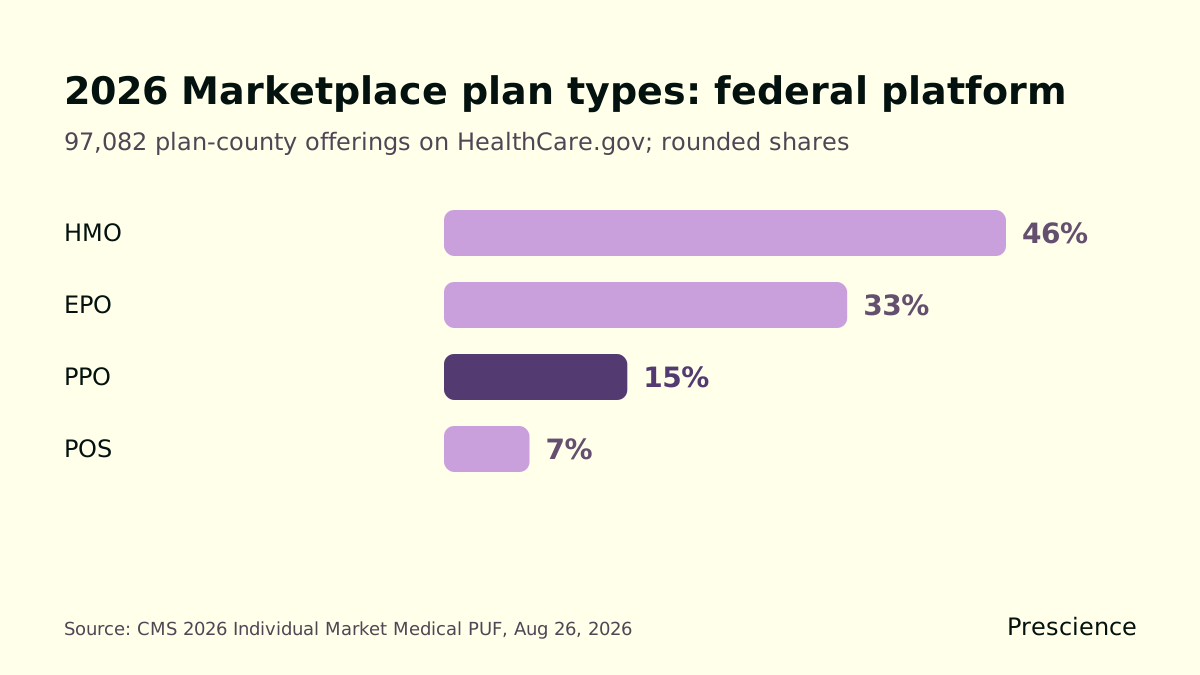
The chart’s rounded 46% HMO, 33% EPO, 15% PPO and 7% POS shares match plan-county listings in CMS’s 2026 federal-platform Marketplace landscape file, not distinct nationwide plans or enrollment. The same plan appears in multiple counties. Deduplicating that file by standard component plan ID gives about 52% HMO, 27% EPO, 10% PPO and 10% POS. Rounding can prevent totals from equaling 100%. HMO and EPO coverage generally restricts routine out-of-network care, but emergency services and other legal or contractual exceptions require separate review.
The premium tax credit trap
This is the part most employees never hear about. When an employer offers an ICHRA, the employee's eligibility for marketplace subsidies depends on whether the offer counts as affordable:
- Affordable ICHRA: the employee can't get a premium tax credit for any month the ICHRA is offered, whether or not they use it.
- Unaffordable ICHRA: the employee can opt out and claim the premium tax credit instead, if their income qualifies. If they accept the ICHRA, they lose the credit.
- The test: the ICHRA is affordable if the cost of the lowest-cost silver plan for self-only coverage, minus the monthly allowance, is no more than 9.96% of household income for 2026 plan years (9.02% in 2025).
So a lower-income employee can end up worse off than if the company offered nothing at all. Without any offer, they might qualify for a large subsidy. With a modest but "affordable" ICHRA, the subsidy disappears and the allowance may cover less than the credit would have. The affordability test also looks only at self-only coverage, so a family can lose subsidies while the allowance covers a fraction of a family plan. You can check the employer side with our ACA affordability calculator.
Who ICHRA really works for
An ICHRA lets the employer choose its allowance, while employees choose qualifying individual coverage. Platform charges are separate. Thatch’s direct Standard pricing lists $45 per enrolled employee monthly plus a $50 monthly compliance charge for employers with 1–49 eligible employees. That published price is a vendor-specific fee, not evidence of an industry margin or a typical ICHRA cost.
ICHRA can work across ages and family types when allowances are sufficient and local coverage fits. It may also simplify purchasing for a dispersed workforce. Conversely, an inadequate allowance or missing provider can make it a poor fit for an employee of any age. I would compare actual household outcomes rather than treating young workers as automatic winners and older workers as automatic losers.
| Your team | ICHRA is a reasonable fit if… | Look elsewhere if… |
|---|---|---|
| Mostly under 35, single | Your local marketplace has several insurers and broad plans | Your area has one or two insurers with narrow HMOs |
| Spread across many states | No group carrier has a usable network everywhere you hire | A national PPO covers where your people live |
| Several parents and older staff | You fund age-scaled and family allowances generously | The budget only stretches to a flat single allowance |
| Lower-wage staff | The allowance is clearly larger than the subsidy they'd lose | An "affordable" offer would wipe out their tax credits |
| Recruiting senior hires | Candidates already buy their own coverage | Candidates compare you with big-company PPO plans |
Red flags in an ICHRA sales pitch
ICHRA isn't a scam, but some of the ways it's sold are misleading. Watch for these:
- "Employees get more choice and better coverage for less." More choice, yes. Better coverage for less only holds if the allowance is generous and the local market is healthy. Ask to see actual plan prices for your oldest employee and your largest family.
- Savings shown against your current group renewal only. The employer saves; the comparison rarely shows what employees now pay out of pocket.
- No mention of the premium tax credit rules. If the vendor can't explain affordability, they haven't modeled your lower-income staff.
- Allowances that don't move with premiums. If premiums rise 26% and the allowance rises 3%, your team just took a pay cut.
- Fees quoted per enrolled employee without the minimums. Read the pricing page for platform fees, minimums and what large-employer compliance costs.
- Price your three hardest cases Your oldest employee, your largest family and your lowest-paid employee. Get real marketplace quotes for each in their ZIP code.
- Compare total cost to each person Annual premium gap plus expected cost sharing, or the out-of-pocket maximum for a high-use scenario, against what they pay on your group plan today.
- Check networks Make sure the hospital and doctors your team actually uses are in at least one plan at each price point.
- Model the tax credit For anyone who might qualify for subsidies, compare the allowance with the credit they'd lose.
- Decide who helps employees Someone has to answer "is this doctor in network?" and "why was this denied?" Ask whether the platform does that or only reimburses.
Support matters after enrollment
I want a benefits proposal to say who helps after the plan is selected. Ask who checks provider participation, helps with enrollment errors and explains how to appeal a denied claim. The individual insurer still makes coverage decisions under its contract; an HRA administrator cannot promise approval. A named support channel and an escalation procedure make the practical responsibility clear without assuming employees must manage everything alone.
If you want to go deeper on the switch itself, read Should we switch from a group plan to ICHRA? and Why are insurers pushing ICHRA?
If your employer just moved you to ICHRA
- Read the notice. It states the benefit terms, substantiation and opt-out procedures, and explains the tax-credit interaction. Use the stated allowance and household information to check your own affordability; the notice does not determine your personal tax-credit eligibility.
- Check your income against the subsidy rules. If the offer is unaffordable for you, opting out and claiming the premium tax credit may be worth more than the allowance.
- Shop on networks first, price second. Search for your doctors and nearest hospital in each plan's directory before comparing premiums.
- Price the whole year. Add 12 months of premium gap to the applicable out-of-pocket maximum for a high-use comparison. Do not add the deductible again because covered in-network deductible payments count toward that maximum. A cheap bronze plan can cost more than a gold plan if you expect care.
- Watch the enrollment window. Gaining an ICHRA (or losing a group plan) opens a special enrollment period, usually 60 days, so you don't have to wait for open enrollment.
- Keep receipts and proof of coverage. Reimbursement depends on showing you're enrolled in individual coverage.
A better way to cap your costs
If what you want from ICHRA is a predictable cost, you can get that from a group plan too:
For employers choosing group coverage, at Prescience we design and run your company's group health plan, from setup and enrollment to claims, compliance and COBRA. What your team gets:
- An effective $0 deductible, so the plan helps from the first visit.
- Simple copays shown before a visit, capped by a low out-of-pocket maximum.
- A broad national PPO network, plus providers we contract with directly.
- 24/7 physician-led care navigation: a care team that finds the right provider, books appointments and explains costs up front.
What your company gets: one monthly cost set in your quote, usually 10–20% below comparable fully insured coverage and fixed before the plan starts, with no admin fees. You keep your payroll provider, and the plan can start mid-year.
Test affordability separately from the preferred plan
For an illustrative employee with $48,000 annual household income, the 2026 threshold is $48,000 × 9.96% ÷ 12 = $398.40 monthly. If the applicable lowest-cost silver self-only premium is an assumed $800 and the monthly ICHRA amount used in the test is $450, the required contribution is $350. That is affordable under these assumptions even if the employee prefers a more expensive plan. This calculation is not a quote or an individual tax determination.
Employer safe harbors used to avoid shared-responsibility penalties and the employee’s household-income test serve different purposes. A payroll-based safe harbor does not establish the household’s premium-tax-credit result. Related individuals offered ICHRA coverage also need review under the ICHRA rules, which differ from the family affordability test for a traditional employer plan. If the employee declines an unaffordable ICHRA, tax-credit eligibility still depends on the other Marketplace requirements.
Before implementation, record the applicable class, allowance, eligible relatives, notice date, coverage substantiation and opt-out procedure. Confirm the special enrollment deadline before ending existing coverage. For employees already receiving advance credits, use the Marketplace process to report the new offer promptly. The provider’s sales estimate is not a substitute for the Marketplace determination or annual tax reconciliation.
What the published averages actually measure
PeopleKeep’s $583 monthly allowance figure describes single employees at businesses with 5–49 employees in its 2025 customer report. It is not a national allowance standard or a promise of available coverage. KFF’s October 2025 analysis estimated a 26% average increase in gross Marketplace premiums for 2026. Gross premiums are not the same as households’ payments after tax credits, and individual changes differ. Compare the final local premium, employer allowance and any tax-credit eligibility for each employee.
KFF’s later analysis put the average deductible across selected Marketplace coverage at $3,786 for 2026, versus $2,759 in 2025. Enrollment moving between metal levels affected that average. It does not show what a fixed plan’s deductible did or predict an employee’s spending. Network types also differ by market: CMS public-use files cover federal-platform Marketplace states, not every US individual plan. A national-looking network chart cannot substitute for checking the exact local plan, providers and out-of-network terms.
See what your team would pay with Prescience
Answer a few questions about your team and get a quote in about 60 seconds, or talk it through with one of our benefits experts.