What employers pay on average
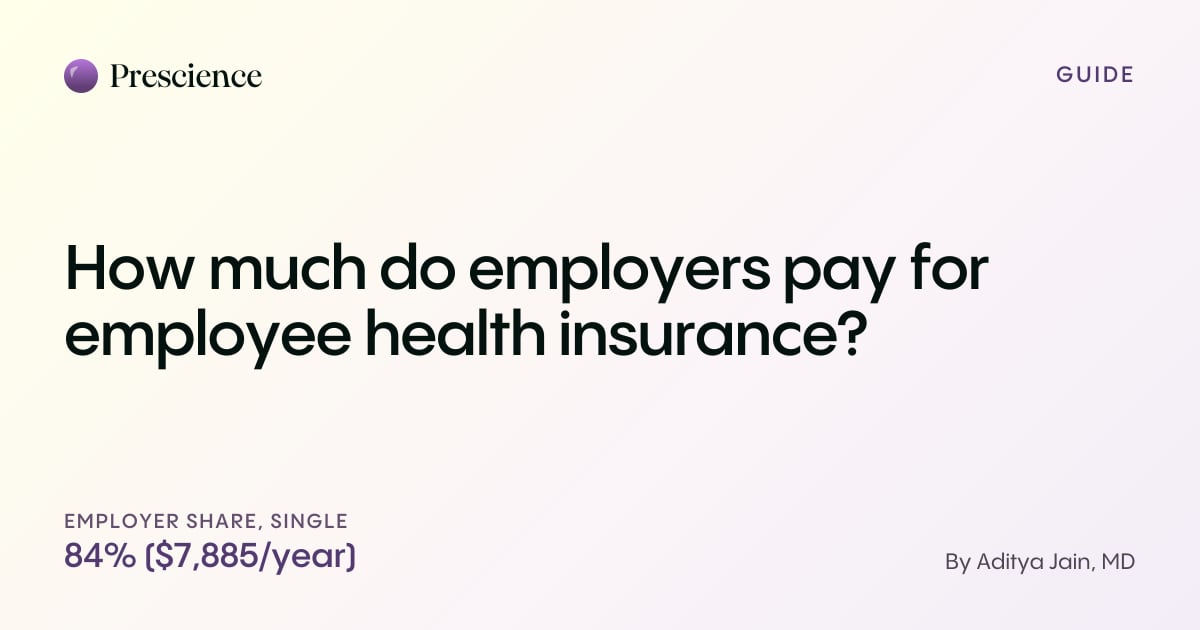
KFF's 2025 survey found covered workers contribute 16% of the premium for single coverage and 26% for family coverage. That leaves employers paying 84% and 74%, or about $7,885 and $20,143 a year ($657 and $1,679 a month).
| All firms | Small firms (10–199) | Large firms (200+) | |
|---|---|---|---|
| Employer share, single | 84% | 84% | 84% |
| Employer share, family | 74% | 64% | 77% |
| Family premium | $26,993 | $26,054 | $27,280 |
| Worker pays for family | $6,850 | $8,889 | $6,227 |
| Employer pays for family | $20,143 | About $17,165 | About $21,053 |
KFF's 2025 sample covers firms with at least ten workers. Its average percentage contributions and average dollar contributions are separately weighted measures, so multiplying one published average by another need not reproduce the dollar figure. At small firms, 29% of covered workers face more than half the family premium, versus 5% at large firms. That describes covered workers, not all employees or all companies.
Are there minimums?
- Carrier rules. Ask for the actual employer contribution, minimum participation and valid-waiver rules. These vary by state and product. A rule for one carrier is not a universal federal minimum.
- November 15–December 15. Under federal guaranteed-availability rules, small groups that miss contribution or participation requirements have an annual enrollment opportunity. Confirm application timing and effective date with the insurer; other eligibility rules still apply.
- ACA affordability. ALE status generally uses the prior-year average of full-time employees plus equivalents, including aggregation rules. For plan years beginning in 2026, the affordability percentage is 9.96%. Employer safe harbors can use W-2 wages, rate of pay or the federal poverty line rather than household income. Minimum value and offer requirements also matter.
- Smaller employers. Federal ACA shared-responsibility penalties generally do not apply below ALE size, but state obligations and other benefits rules can still apply.
- Tax credit. The small business credit generally requires a uniform contribution of at least 50% of employee-only coverage, plus employee-count, wage and SHOP conditions, with limited exceptions.
Six contribution policies, priced for a 10-person team
The same team can cost the company anywhere from about $47,000 to $146,000 a year depending on the policy. This example uses KFF's 2025 national averages: $777 a month for single coverage and $2,249 for family coverage (so dependents add $1,472 a month). Seven employees enroll alone; three cover families.
| Policy | Single employee pays | Family employee pays | Company pays per month | Company pays per year |
|---|---|---|---|---|
| 50% of employee-only | $388.50 | $1,860.50 | $3,885 | $46,620 |
| 75% of employee-only | $194.25 | $1,666.25 | $5,827.50 | $69,930 |
| Flat $600 a month each | $177 | $1,649 | $6,000 | $72,000 |
| 100% of employee-only | $0 | $1,472 | $7,770 | $93,240 |
| 100% employee + 50% dependents | $0 | $736 | $9,978 | $119,736 |
| 100% of everyone | $0 | $0 | $12,186 | $146,232 |
Which policy fits?
- 50% of employee-only: low employer spending in this illustration, but $1,860.50 monthly for each family enrollee. Test actual affordability rather than assuming a carrier minimum meets employee needs.
- 75% of employee-only: the company pays more, but families still owe $1,666.25 monthly in this example.
- Flat $600: fixes the per-enrollee contribution, not total spending if enrollment grows. Where age rating applies, equal allowances can leave different employee balances.
- 100% of employee-only: removes the employee-only payroll deduction, but dependent coverage still costs $1,472 monthly here.
- 100% employee plus half of incremental dependents: lowers the family payroll deduction to $736. Specify that the percentage applies to the incremental cost, not the entire family premium.
- 100% of everyone: transfers all modeled premium spending to the company. Employees still face the policy's cost sharing when they receive care.
Tax treatment: why a premium dollar beats a salary dollar
- For the company: qualifying employee health premiums generally can be deducted as a business expense. Tax-credit coordination and owner treatment can change the result.
- For employees: employer-provided qualifying accident and health coverage is generally excluded from federal income and payroll taxes. Owners and some family or domestic-partner situations require separate review.
- Employee share: with a Section 125 premium-only plan, employees pay their share before income and payroll tax. See Section 125 explained.
- More-than-2% S corporation shareholders: special W-2 income inclusion and possible self-employed health insurance deduction rules apply. Social Security and Medicare exclusions require the applicable plan conditions; do not process them as ordinary cafeteria-plan employees.
- Sole proprietors and partners are not employees for this purpose; they generally use the self-employed health insurance deduction instead.
- Reporting: W-2 cost reporting has its own rules and transition relief, including relief for employers filing fewer than 250 W-2s in the preceding year. Code DD is informational, not a new tax. Confirm which coverage and employer exceptions apply.
Turn the contribution policy into an employee explanation
I would show candidates and employees a dollar table for each enrollment tier, including dependents. A percentage alone can be misleading: paying 75% of the whole family premium is different from paying the entire employee-only amount plus 75% of the incremental dependent premium. State the formula and the resulting payroll deduction together.
The contribution policy pays for enrollment, not every service. In a fictional plan with a $3,000 unmet deductible, a covered MRI with a $3,000 allowed amount could still cost the employee $3,000 even when the company pays every premium dollar. Use examples from the actual policy to show this distinction during enrollment.
Edge cases founders run into
- Part-time staff. Eligibility depends on the plan and applicable law. For ACA shared responsibility, full-time generally means 30 hours of service weekly or 130 monthly, with permitted measurement methods. Do not assume a simple job label decides eligibility.
- Different contributions. Have the administrator review proposed employee classes under the relevant tax nondiscrimination, health-status nondiscrimination and state rules. A bona fide class is not automatic permission to favor owners or highly compensated employees.
- Remote employees in other states. One group plan can cover employees in several states if its network reaches them. Check the network where each person lives before you set one contribution for all. See health insurance for remote employees.
- Medicare-age workers. Review Medicare Secondary Payer rules before changing eligibility or contributions. The age-based working-employer rule generally uses a 20-employee test, but disability, ESRD and multiemployer situations have different rules.
- Waiting periods. Once an employee is otherwise eligible, a group health plan generally cannot impose a waiting period longer than 90 days. Check the actual effective-date calculation and permitted eligibility conditions.
- Midyear changes. Review plan amendments, insurer terms, notices and Section 125 election rules before changing contributions. Do not assume employees can automatically change elections in response to any adjustment.
How to set your contribution
- Start from your hiring market Ask which benefits and payroll deductions matter to your hiring market without collecting personal diagnoses. Decide what the company can sustain under several enrollment scenarios.
- Price employee-only coverage first Decide whether the company pays 75% or 100% of each employee's own coverage. This drives most of your cost.
- Then decide on dependents Choose 0%, 50%, 75% or 100% of the extra cost of a spouse or children. Model it with your real census; three families on a ten-person team change the bill a lot.
- Model two years, with fees Add all quoted fees and model several explicitly hypothetical renewals. Fixed-dollar and percentage policies distribute future premium increases differently; neither fixes total spending when enrollment changes.
- Compare what employees experience Put the paycheck deduction, deductible and out-of-pocket maximum for each option in one table. That is the number employees will compare with their last job.
- Write it down and apply it consistently Put the policy in your plan documents and offer letters, and apply it the same way to everyone in each class.
At Prescience, we design and run your company's health plan, from setup and enrollment to claims, compliance and COBRA. What your team gets:
- An effective $0 deductible, so the plan helps from the first visit.
- Simple copays shown before a visit, capped by a low out-of-pocket maximum.
- A broad national PPO network, plus providers we contract with directly.
- 24/7 physician-led care navigation: a care team that finds the right provider, books appointments and explains costs up front.
What your company gets: one monthly cost set in your quote, usually 10–20% below comparable fully insured coverage and fixed before the plan starts, with no admin fees. You keep your payroll provider, and the plan can start mid-year.
See what your team would pay with Prescience
Answer a few questions about your team and get a quote in about 60 seconds, or talk it through with one of our benefits experts.