How an HSA works
An HSA pairs with a high-deductible health plan (HDHP). You, your employer or both put money in. You spend it on qualified medical expenses, from doctor visits and prescriptions to dental and vision care, or you let it grow. The money is yours: it stays with you when you change jobs and never expires.
I value the combination of federal benefits: eligible contributions are excluded or deductible, earnings grow tax-free, and qualified withdrawals are tax-free. State rules may differ. Nonqualified withdrawals can be taxable, so the account is not a blanket exemption for any spending.
- Anyone can contribute for you: you, your employer or a family member. All of it counts toward one annual limit.
- You choose when to spend it. IRS Publication 969 lets you take tax-free money out for qualified expenses you had after you opened the HSA, and you don't have to take it out in the same year. Keep the receipts.
- You may be able to invest it. Some custodians offer investments, with their own cash minimums, fees and investment choices. Money invested can lose value, so keep expected near-term medical spending accessible.
- After 65 it behaves like a traditional IRA. Withdrawals for non-medical spending are taxed as income but no longer carry the 20% penalty. Before 65, non-medical withdrawals are taxed and penalized 20%, unless you're disabled.
- Some premiums are allowed. HSA money can pay COBRA premiums, coverage while you collect unemployment, qualified long-term care insurance within age-based annual limits and, from 65, Medicare premiums (not Medigap). Ordinary premiums are not qualified expenses.
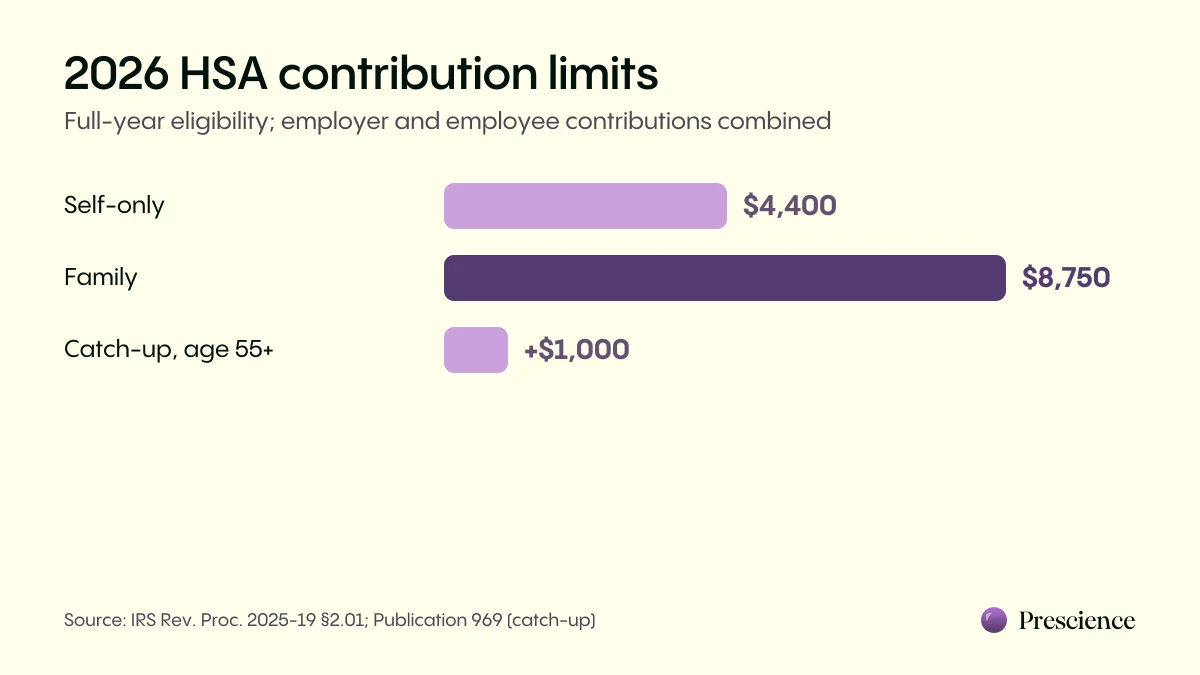
2026 HSA limits
| Self-only | Family | |
|---|---|---|
| HSA contribution limit | $4,400 | $8,750 |
| Catch-up contribution, age 55+ | +$1,000 | +$1,000 |
| HDHP minimum deductible | $1,700 | $3,400 |
| HDHP out-of-pocket maximum | $8,500 | $17,000 |
Employer and employee contributions count toward the same limit. If your employer puts in $1,000 and you have self-only coverage, you can add $3,400 more. You have until the tax filing deadline to contribute for a year, so 2026 contributions can be made until April 15, 2027.
The limit depends on the coverage you have, not on how many people live in your house. Family coverage means the HDHP covers you and at least one other person. If you switch from self-only to family coverage partway through the year, the limit is figured month by month (or with the last-month rule below).
What changed for 2026
The One, Big, Beautiful Bill Act widened HSA eligibility starting January 1, 2026:
- Bronze and catastrophic individual plans now count as HSA-compatible, even if they don't meet the usual HDHP definition. The relief covers qualifying individual-market plans available through an Exchange, including off-Exchange purchases, with IRS good-faith relief described in Notice 2026-5. It does not make every employer bronze plan eligible.
- Direct primary care: certain qualifying arrangements no longer block contributions from January 1, 2026. To preserve contribution eligibility, aggregate monthly fees cannot exceed $150 for one person or $300 for an arrangement covering more than one person. Services must meet the statutory definition; not every concierge membership qualifies. Qualified DPC fees can be paid from an HSA even when the fee exceeds that eligibility threshold, but employer-paid fees cannot also be reimbursed tax-free.
- Telehealth before the deductible is permanently allowed without breaking HSA eligibility, for plan years starting on or after January 1, 2025.
The limits themselves rose by the usual inflation step: $100 for self-only coverage (from $4,300) and $200 for family coverage (from $8,550). The catch-up amount is set by statute and stays at $1,000.
What an HSA saves you in real dollars
The savings depend on your tax bracket and on how the money goes in. Contributions through payroll under your employer's cafeteria plan avoid federal income tax and applicable FICA, generally 7.65% below the Social Security wage base. Contributions you make on your own at your bank are deductible on your return, but you still paid FICA on that pay. That difference is worth using payroll if you can.
Eligibility edge cases that trip people up
You're eligible for a month if, on the first day of that month, you're covered by an HSA-eligible plan, you have no disqualifying other coverage, you're not enrolled in Medicare and nobody can claim you as a dependent. Most mistakes come from the second and third conditions.
| Situation | What happens to your HSA |
|---|---|
| You enroll in Medicare (Part A, B or both) | Your limit is zero from the first month you're enrolled. You keep and can spend the existing balance. |
| You apply for Medicare or Social Security after 65 | Premium-free Part A starts up to 6 months before you sign up (never before the month you turned 65). Contributions in those backdated months become excess contributions. |
| Your spouse has a general-purpose health FSA | If that FSA can pay your medical bills, you're not eligible, even though it's your spouse's employer's plan. A limited-purpose (dental and vision) FSA is fine. |
| You had a general-purpose FSA last year with a carryover | The carryover keeps you covered by that FSA into the new year and can block HSA eligibility unless the employer converts it to limited-purpose. |
| You join an HDHP mid-year | Prorate by month, or use the last-month rule if you're eligible on December 1 and stay eligible through the next year. |
| You use VA care for a service-connected disability | Doesn't disqualify you, per IRS Publication 969. |
| Both spouses are 55 or older | Each can add the $1,000 catch-up, but only into their own HSA. There are no joint HSAs. |
| Your adult child (under 26) is on your family plan | If they cannot be claimed as anyone’s tax dependent and meet all other eligibility rules, they can contribute to their own HSA based on their family coverage and eligible months. |
Excess contributions cost 6% a year until you fix them. If you catch the mistake by your tax return due date, including extensions, ask your HSA provider to remove the excess and its earnings.
The catch: the deductible
An HSA balance and insurance coverage solve different budgeting problems. A qualifying HDHP generally has a deductible of at least $1,700 self-only or $3,400 family in 2026, subject to exceptions including the new individual bronze and catastrophic rules. You can keep an existing HSA without qualifying to make new contributions. Before choosing a plan, compare available cash with early-year medical exposure, not just the potential tax deduction.
An HSA can be useful for people with frequent or infrequent care needs. Compare premiums, covered services, employer contributions and the out-of-pocket maximum. A person with substantial expected care should not reject an HDHP solely because of the deductible, or select it solely for the tax benefit. The total annual cost and timing of bills determine whether it fits.
How employers can make the deductible disappear
Employers can contribute to employees' HSAs too, and those dollars can cover the deductible so employees don't feel it. Employer money in an HSA belongs to the employee, so it's a benefit people actually notice. KFF's 2025 survey put the average employer HSA contribution at $690 a year for single coverage and $1,296 for family coverage, counting employers that give nothing.
| Strategy | How it works | Trade-off |
|---|---|---|
| Flat seed | Same dollar amount for everyone in a coverage tier, e.g., $750 single and $1,500 family | Simple and fair; doesn't reward saving |
| Match | Match employee contributions up to a cap, e.g., 50% up to $1,000 | Rewards savers; lower earners often get less. Must run through a cafeteria plan |
| Fund the deductible | Contribute enough to cover all or most of the deductible | Offsets eligible expenses without changing the insurance deductible; uses more employer budget |
| Front-load in January | Deposit the full year on day one | Money is there for an early-year bill; the balance generally stays with the employee after departure, subject to narrow correction rules |
| Per paycheck | Spread contributions over the year | Lower risk for the employer; an early surgery can outrun the balance |
- Comparability rules. Contributions made outside a cafeteria plan generally must meet statutory comparability rules: the same dollar amount or the same percentage of the deductible for comparable participating employees. Coverage and employment categories matter, and special rules permit larger contributions for non-highly compensated employees. Breaking the rule triggers a 35% excise tax on what you contributed. Contributions through a cafeteria plan, including matches, are exempt from comparability but must pass cafeteria plan nondiscrimination tests.
- Payroll taxes. Employer HSA contributions aren't wages for income tax, Social Security, Medicare or FUTA. Payroll tax savings depend on wage levels and employee eligibility; ordinary employee rules do not apply to every owner.
- Report it. Employer contributions, including employee pre-tax deferrals, go on the W-2 in box 12, code W.
- Owners are different. More-than-2% S corporation shareholders and partners can't receive pre-tax employer HSA contributions the same way employees do. Their contributions are treated as pay, which they can then deduct on their own return.
At Prescience, we design and run your company's health plan, from setup and enrollment to claims, compliance and COBRA. What your team gets:
- An effective $0 deductible, so the plan helps from the first visit.
- Simple copays shown before a visit, capped by a low out-of-pocket maximum.
- A broad national PPO network, plus providers we contract with directly.
- 24/7 physician-led care navigation: a care team that finds the right provider, books appointments and explains costs up front.
What your company gets: one monthly cost set in your quote, usually 10–20% below comparable fully insured coverage and fixed before the plan starts, with no admin fees. You keep your payroll provider, and the plan can start mid-year.
Do not assume a Prescience proposal permits HSA contributions from the deductible description alone. Ask for a written eligibility determination for the actual coverage. Existing HSA funds remain yours even when new contributions are unavailable. Compare any tax advantage with premiums, copays and practical access to care.
HSA vs. FSA vs. HRA
| HSA | Health FSA | HRA | |
|---|---|---|---|
| Who funds it | Employee and employer | Mostly employee | Employer only |
| Who owns it | Employee | Employer plan | Employer plan |
| 2026 limit | $4,400 self-only, $8,750 family | $3,400 per employee in salary reductions | Set by the employer (QSEHRA capped at $6,450 / $13,100) |
| Rolls over | Yes, forever | Up to $680 carryover, or a grace period, if the plan allows | Per plan design |
| Needs an HDHP | Yes (or an eligible bronze/catastrophic plan) | No | No |
| Can be invested | Yes | No | No |
| Leaves with the employee | Yes | No (COBRA may apply) | No, unless the plan allows |
You can pair an HSA with a limited-purpose FSA for dental and vision costs and stay eligible. A general-purpose FSA or HRA that pays medical bills before the deductible disqualifies you. For what each account can pay for, see HSA and HRA eligible expenses.
How to open and use an HSA
- Confirm your plan qualifies Check whether the plan meets all HDHP requirements, including the out-of-pocket limit and restrictions on early benefits, or qualifies for the individual bronze/catastrophic exception. A large deductible alone does not establish HSA eligibility.
- Check for disqualifying coverage Ask your spouse whether they have a general-purpose health FSA. Check whether you're enrolled in any part of Medicare or about to apply.
- Open the account Use your employer's HSA provider if it offers payroll deductions, since that saves FICA tax. Otherwise any bank or brokerage that offers HSAs works. Compare monthly fees and investment options.
- Set your contribution Subtract your employer's contribution from the limit, then choose a per-paycheck amount. You can change it during the year.
- Decide: spend or invest Keep enough cash for your deductible. If you can, pay small bills out of pocket, keep the receipts and invest the rest.
- File Form 8889 Report contributions and withdrawals on Form 8889 with your tax return. Your provider sends Form 5498-SA and Form 1099-SA.
See what your team would pay with Prescience
Answer a few questions about your team and get a quote in about 60 seconds, or talk it through with one of our benefits experts.