What the large-employer data does and does not prove
FAANG is a shorthand for several technology companies, not a single health plan. Benefits vary by employer, country, employment category and year. I would not promise a candidate that every technology company offers the same deductible, fertility benefit or family contribution. Ask for the current benefits materials when making a specific comparison. A national employer survey describes a market pattern; it cannot establish the terms of an individual company plan.
KFF defines large firms here as those with at least 200 workers. Its deductible comparison is for covered workers in plans with a general annual deductible for single coverage. That qualifier matters: the figures are not the average medical spending of all employees, and they do not include every possible plan design. The survey also excludes employers with fewer than ten workers in 2025. A five-person startup should use these results as context, not a predicted quote.
Most importantly, the survey does not prove that self-funding causes richer benefits. Employer budgets, workforce composition, contribution policy and purchasing choices can differ at the same time. A company can self-fund a high-deductible plan or purchase a generous insured plan. The funding arrangement tells you who bears claims risk; the benefit schedule tells you what the employee pays. Keep those questions separate when assessing an offer.
Separate the financing decision from the benefit decision
Consider a hypothetical company comparing two designs for 100 employees, all with employee-only enrollment. Assume the total annual plan budget is unchanged at $900,000. This is a contribution illustration, not a claims projection or a market quote. It shows why two employers buying similar coverage can produce very different employee experiences.
A founder should therefore request three separate comparisons: total employer expense, employee payroll contributions and employee medical exposure. Add dependent tiers and realistic enrollment assumptions before using the budget. If richer contributions cause people to join who previously waived coverage, the enrollment increase belongs in the forecast. A comparison using the old enrollment count can understate the cost of an otherwise sensible improvement.
For a self-funded employer, expected claims are not a guaranteed annual bill. Administrative charges, network costs and any risk protection also belong in the budget. Compare a plausible high-claims scenario with available cash, not just the expected result. For an insured employer, understand renewal uncertainty and the services included in the premium. Neither arrangement removes the need to plan for next year.
The operational work behind a rich benefit
A benefits team needs more than purchasing power. Someone must maintain eligibility records, review invoices, explain enrollment, coordinate payroll and monitor service quality. Vendors can perform those tasks, but the employer still needs an accountable owner. A startup can copy this discipline before it has the scale to copy a large employer financing arrangement. Name the owner of each process and keep an escalation path for employees.
Navigation is useful when it helps a person act: find an appropriate in-network provider, understand a referral, arrange an appointment or resolve a confusing bill. Ask a potential navigation vendor what it can actually do and what depends on the plan. Support does not override coverage exclusions or guarantee authorization. A friendly service that cannot connect with the plan administrator may leave the employee doing the same work twice.
Special programs need the same scrutiny. For fertility care, mental health or weight management, ask about eligibility, covered services, clinical requirements, limits and geographic availability. Do not compare programs only by their names. One program may provide coaching while another covers medical treatment. Request the current written benefit terms and give employees a private channel for checking their circumstances before enrollment.
What a small company can copy this quarter
First, write a benefits promise that fits the company budget. Describe the employee contribution, financial exposure, provider access and support experience you want. Second, collect comparable quotes using one census and the same effective date. Third, test the details in the Summary of Benefits and Coverage and full plan documents. These steps work whether you keep a PEO, buy insured coverage or evaluate another arrangement.
Before switching, review treatment continuity and deductible credit. An employee who has already met a deductible can be worse off if the replacement plan resets it mid-year. Ask for written terms rather than assuming credits transfer. Confirm prescription access and any pending authorizations privately with the employee and administrator. A transition that preserves care may justify a later start date even when an earlier switch looks cheaper.
Finally, measure the employee experience after enrollment. Did the correct dependents receive coverage? Do deductions match the contribution policy? Can people find appointments and get billing help? Review those questions alongside renewal cost. The point of borrowing from large employers is to make healthcare easier to use and financially manageable, not to acquire the largest possible collection of benefit vendors.
The secret is self-funding
When a large company self-funds, the employer bears claims costs rather than buying a conventional insured group policy. The company pays the actual cost of its employees' care, plus a fee to an administrator (often the same carriers, acting as administrators). It can retain favorable claims results, subject to its vendor contracts, but also bears adverse claims experience. Access to claims reporting and flexibility in design still come with federal compliance duties.
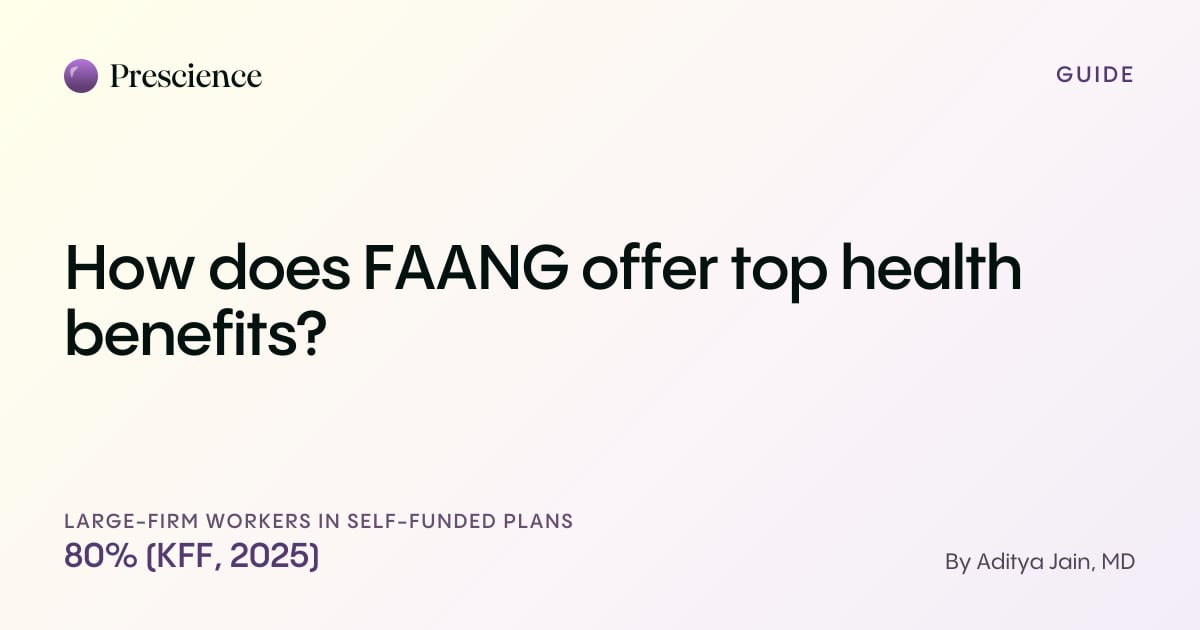
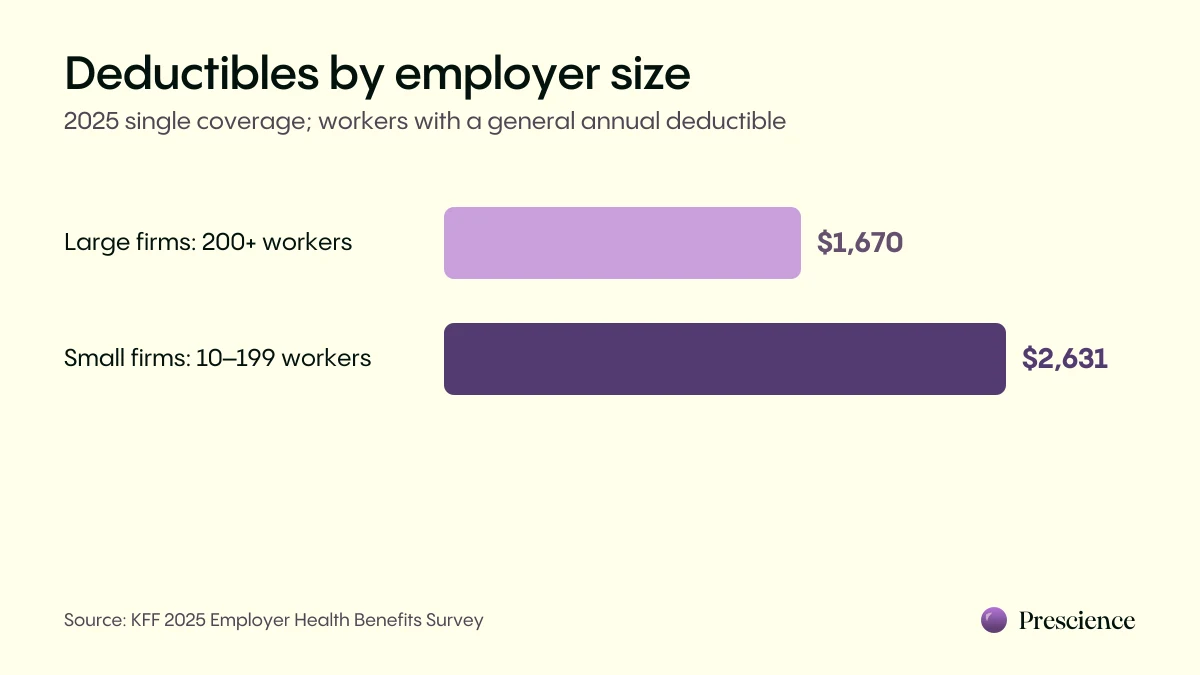
KFF's 2025 survey shows the gap clearly: 80% of covered workers at larger firms are in self-funded plans, compared with 27% at firms with 10–199 workers. The average deductible at larger firms was $1,670; at small firms, $2,631.
What large employers layer on top
- Lower employee cost sharing, if the employer funds that benefit in its budget.
- Navigation and advocacy so employees get to the right doctor the first time.
- Direct contracts and centers of excellence for expensive procedures, at negotiated prices.
- Coverage choices smaller plans skip. KFF found 43% of firms with 5,000 or more workers cover GLP-1 drugs for weight loss.
Why startups usually can't copy it
Self-funding works at scale because thousands of employees average out. A 20-person company can have one premature birth or cancer diagnosis that costs more than its whole expected year. Small employers who self-fund buy stop-loss insurance to cap that risk, but stop-loss carriers underwrite your group, and some states restrict it: New York bans stop-loss for small groups entirely.
I would copy the large employer’s purchasing discipline before copying its financing. Assign an owner for enrollment, benefits questions and vendor reviews, and measure whether employees can use the coverage they were promised.
Where Prescience fits for a startup
Prescience designs and runs company health plans starting at 2 employees.
At Prescience, we design and run your company's health plan, from setup and enrollment to claims, compliance and COBRA. What your team gets:
- An effective $0 deductible, so the plan helps from the first visit.
- Simple copays shown before a visit, capped by a low out-of-pocket maximum.
- A broad national PPO network, plus providers we contract with directly.
- 24/7 physician-led care navigation: a care team that finds the right provider, books appointments and explains costs up front.
What your company gets: one monthly cost set in your quote, usually 10–20% below comparable fully insured coverage and fixed before the plan starts, with no admin fees. You keep your payroll provider, and the plan can start mid-year.
The quoted plan documents determine your benefits. Compare employee contributions, copays, network access and the out-of-pocket maximum against the alternatives your team is considering.
How to compare a specific technology-company offer
If a candidate compares your offer with a former employer, ask for the current benefit summary they are comfortable sharing, without requesting medical information. Record the coverage year, employee contribution tier and exact plan option. A company may offer several options, and a former employee’s recollection may describe a different year or location. Do not turn a national average into a claim about Google, Apple, Amazon, Meta or Netflix.
Build a short comparison that includes specialist visits, prescriptions, inpatient care, fertility services if relevant, and dependent premiums. Mark any missing information as unknown. For a family expecting substantial care, compare annual payroll contributions plus the in-network out-of-pocket limit rather than simply comparing deductibles. Add access checks for hospitals and treating clinicians. That gives a candidate something concrete to evaluate without claiming that your plan reproduces another employer’s entire benefits package.
See what your team would pay with Prescience
Answer a few questions about your team and get a quote in about 60 seconds, or talk it through with one of our benefits experts.